
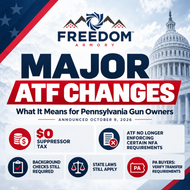
Major ATF Changes Announced October 9, 2026: What Firearm Owners Need to Know
Oct 12th 2026
The firearms industry is seeing some major changes following an announcement from the Bureau of Alcohol, Tobacco, Firearms and Explosives (ATF) on October 9, 2026.
The ATF announced that it will no longer enforce several National Firearms Act (NFA) requirements involving suppressors, short-barreled rifles (SBRs), short-barreled shotguns (SBSs), and certain other firearms.
For firearm owners, this represents a significant shift in federal regulation. However, the announcement does not eliminate all firearm purchasing requirements, and individual state laws still play an important role.
Here's what changed, what hasn't, and what firearm owners in Pennsylvania should know.
What Changed on October 9?
On October 9, 2026, the Department of Justice and ATF announced a new enforcement policy affecting several categories of firearms and devices regulated under the National Firearms Act.
Under the new guidance, the ATF will no longer enforce certain federal requirements involving registration, tax stamps, and prior approval for making or transferring the following items:
-
Suppressors (Silencers): Devices designed to reduce the sound of a firearm's discharge.
-
Short-Barreled Rifles (SBRs): Rifles with barrels shorter than 16 inches, or otherwise meeting the applicable federal definition.
-
Short-Barreled Shotguns (SBSs): Shotguns with barrels shorter than 18 inches, or otherwise meeting the applicable federal definition.
-
Any Other Weapons (AOWs): Certain concealable firearms classified separately under the NFA.
The change follows an August 5, 2026, federal court decision in Silencer Shop Foundation v. ATF.
The court determined that certain NFA requirements were no longer valid exercises of Congress's taxing authority after legislation reduced the making and transfer taxes on these items to $0.
Although the court's injunction applied only to certain parties, the Department of Justice decided to extend its nonenforcement policy nationwide.
Source: [1], [2]
Does This Mean Suppressors No Longer Require Tax Stamps?
Under the ATF's October 9 guidance, the agency will no longer enforce the NFA's tax-stamp, registration, and prior transfer-approval requirements for suppressors covered by the announcement.
This is a major change from the traditional federal NFA process, which generally required buyers to submit an application, receive federal approval, and register the suppressor before taking possession.
It's also important to distinguish two separate developments:
-
January 1, 2026: The federal making and transfer taxes on suppressors and several other NFA items were reduced to $0.
-
October 9, 2026: The ATF announced that it would stop enforcing certain NFA registration and approval requirements for those items.
However, this does not mean suppressors are completely unregulated.
Suppressors remain subject to the federal Gun Control Act (GCA). Federally licensed dealers must still follow applicable requirements, including:
-
Completion of ATF Form 4473
-
Required background checks
-
Dealer recordkeeping requirements
-
Verification of the customer's legal eligibility
-
Compliance with applicable state and local laws
The ATF will also continue accepting voluntary NFA registration applications, including those submitted to satisfy state-law requirements.
Source: [1], [2]
What About Short-Barreled Rifles and Shotguns?
Short-barreled rifles and shotguns are also covered by the October 9 announcement.
The ATF will no longer enforce certain NFA registration and approval requirements for these firearms. However, their transfer process involves an additional consideration.
Under the Gun Control Act, licensed dealers generally need specific federal authorization to transfer short-barreled rifles and shotguns.
Previously, the NFA approval process also satisfied that authorization requirement.
The ATF has acknowledged that it is developing a new process to address these transfers outside the traditional NFA framework. Until those procedures are established, the agency has announced that it will exercise enforcement discretion regarding the applicable GCA transfer-approval provision.
As a result, firearm dealers must continue monitoring federal guidance and ensuring transactions comply with all other applicable laws.
Source: [2]
How Do These Changes Affect Pennsylvania Gun Owners?
For firearm owners in Pennsylvania, the distinction between federal and state law is especially important.
The ATF's October 9 announcement changes federal enforcement policy. It does not automatically override Pennsylvania firearm laws.
Pennsylvania's Title 18, Section 908 addresses prohibited offensive weapons, including certain firearms and devices designed or adapted for concealed or silent discharge.
The statute also establishes several exceptions and legal defenses, including one involving compliance with the National Firearms Act.
Because Pennsylvania law specifically references NFA compliance, questions remain about how the new federal nonenforcement policy affects certain transfers and possession requirements within the Commonwealth.
Additionally, the ATF has confirmed that states may continue imposing their own requirements and that the agency will continue processing voluntary NFA applications.
For Pennsylvania customers, this means the purchasing or transfer process may differ from that in states without comparable restrictions.
Customers should not assume that an eligible suppressor or short-barreled firearm can automatically be transferred without additional paperwork solely because of the federal announcement.
Before purchasing or transferring an affected item, it is important to confirm the requirements applicable to the specific firearm and transaction.
Source: [2], [3]
What Hasn't Changed?
While the October 9 announcement represents a major development, several important requirements remain in place.
Background Checks Are Still Required
Federally licensed dealers must continue completing ATF Form 4473 and conducting required background checks before transferring covered firearms and devices.
Machine Guns and Destructive Devices Remain Regulated
The announcement does not eliminate NFA requirements for machine guns or destructive devices. These categories remain subject to the applicable $200 making or transfer tax and existing NFA requirements.
State and Local Laws Still Apply
The federal announcement does not override state or local restrictions. Customers must continue complying with the laws applicable to their location.
Certain Interstate Transportation Requirements Remain
Individuals transporting short-barreled rifles or short-barreled shotguns across state lines must still comply with applicable federal authorization requirements. The ATF has stated that Form 20 remains available for obtaining the necessary authorization, whether or not the firearm is NFA-registered.
Dealer Licensing and Business Requirements Remain
Businesses engaged in dealing, manufacturing, or importing NFA firearms and suppressors must continue complying with applicable federal licensing and special occupational tax requirements.
Source: [1], [2]
What Happens Next?
The October 9 announcement represents one of the most significant recent changes to federal NFA enforcement.
However, the situation is still developing.
The ATF has indicated that it is working on additional procedures to address certain transfers, while state-level legal requirements and future court decisions could affect how the new policy is implemented.
It is also important to recognize that the underlying NFA statutes have not all been repealed. The October 9 announcement is an enforcement policy that could be affected by future legal or regulatory developments.
For firearm owners, the most important takeaway is to stay informed and avoid assuming that every previous restriction has disappeared.
At Freedom Armory and, we're keeping an eye on these developments and what they mean for our customers.
As additional information becomes available, we'll continue sharing updates to help firearm owners understand the changing regulatory landscape.
Sources and References
[1] Bureau of Alcohol, Tobacco, Firearms and Explosives (ATF)
ATF Issues Guidance on National Firearms Act Transfers for Short-Barreled Rifles, Short-Barreled Shotguns, Suppressors, and Certain Other Firearms.
Published October 9, 2026.
[2] Bureau of Alcohol, Tobacco, Firearms and Explosives (ATF)
Update to NFA Transfer Guidance — Official Frequently Asked Questions.
Updated October 9, 2026.
https://www.atf.gov/firearms/update-to-nfa-transfer-guidance
[3] Pennsylvania General Assembly
18 Pa.C.S. § 908 — Prohibited Offensive Weapons.
https://www.legis.state.pa.us/WU01/LI/LI/CT/HTM/18/00.009.008.000..HTM
Disclaimer: This article is provided for general informational purposes and does not constitute legal advice. Firearm laws, agency guidance, and enforcement policies may change. Customers should consult current ATF guidance, applicable state laws, and qualified legal professionals regarding specific transactions.